How it works
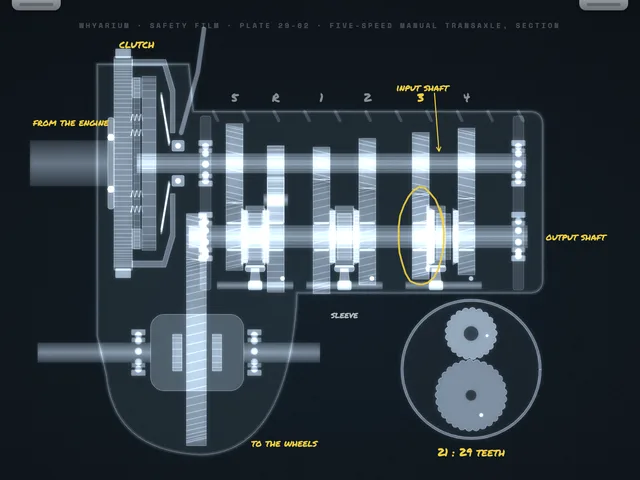
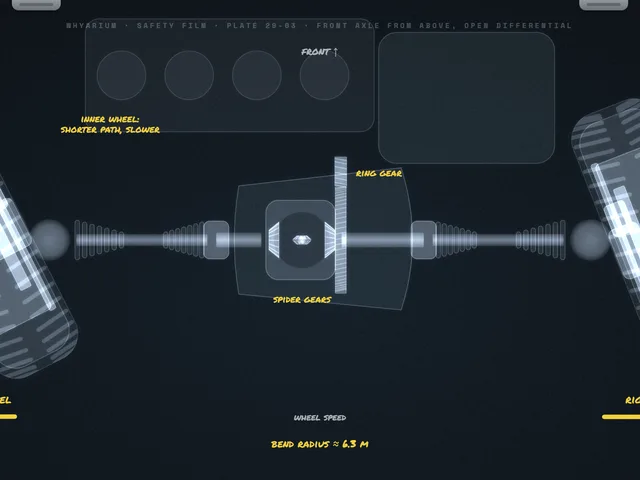
- Final drive. The small pinion on the gearbox output drives a big ring gear. This is the last reduction, about 4 to 1, and it turns the whole differential case.
- The case and its gears. Inside the case, small bevel gears called spider gears sit on a cross pin. They mesh with two side gears, one for each half-shaft.
- Going straight. Both wheels meet the same resistance, so the spider gears don't turn on their pin. The case, both side gears and both wheels all turn together, like one solid lump.
- In a bend. The inner wheel slows down. The spider gears start to roll around it and push the outer side gear faster by exactly the same amount. The case speed is always the average of the two wheels.
- The weak spot. An open differential always gives both wheels the same torque. If one wheel is on ice it can only take a tiny torque, so the other gets just as little, and the icy wheel spins.
By the numbers
averagethe case always turns at the mean speed of the two wheels
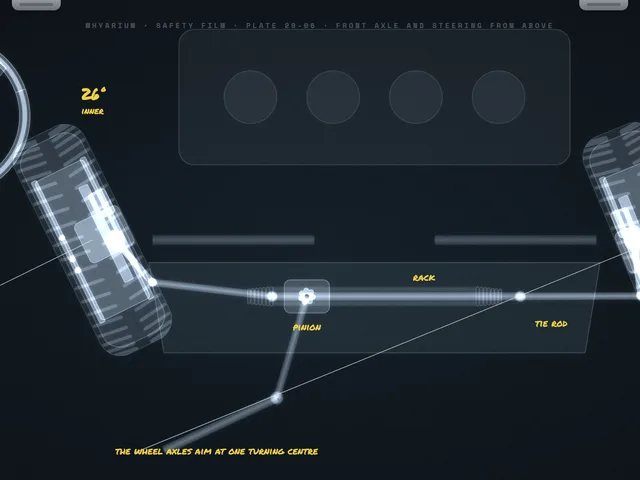
≈ 35 %how much faster the outer wheel turns when the axle's centre follows a 5 m circle, with a 1.5 m track
1827the year a differential gear was patented in France, for a steam carriage
50 : 50torque split of an open differential, whatever the wheels do
Worth knowing
Limited-slip differentials fight that weak spot with clutches or special gears that resist a big speed difference, so some torque reaches the wheel that has grip. Electronic traction control gets a similar result by gently braking the spinning wheel.
When it goes wrong
- Whine or howl at speed
- Worn ring and pinion teeth or their bearings.
- Clunk when pulling away
- Wear in the spider gears or the half-shaft joints.
- Clicking on full lock
- A worn outer CV joint on a front half-shaft, not the differential itself, but it is the next part along.