How it works
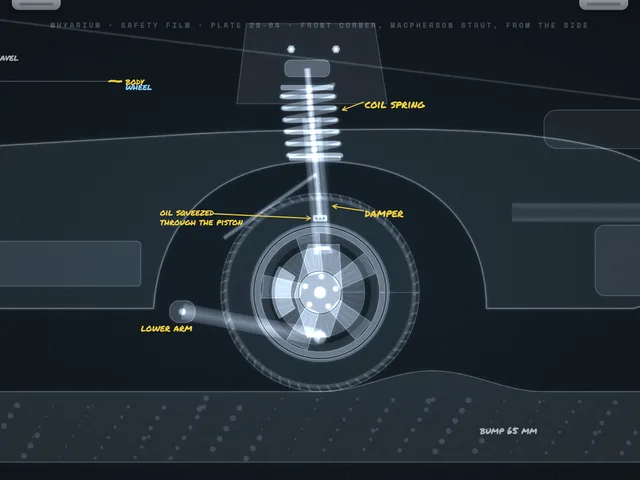
- Carry the weight. The coil spring holds the car up. At a bump it compresses and stores the energy for a moment, so the body barely moves while the wheel jumps.
- Calm the spring. The damper, or shock absorber, is a tube of oil with a piston inside. As the strut moves, oil is forced through tiny valves in the piston. That resistance soaks up the spring's energy and turns it into heat.
- Keep the tyre down. A tyre only grips while it presses on the road. Good damping stops the wheel from hopping, so it can steer and brake on uneven ground.
- The strut. In a MacPherson strut the damper is also part of the structure: it holds the wheel hub at the bottom and is bolted to the body at the top, with a single lower arm doing the rest.
By the numbers
≈ 1–1.5 Hzhow fast a comfortable car body bobs on its springs
≈ 10–15 Hzhow fast the wheel bounces on its own between tyre and spring (wheel hop)
1950the first production car with MacPherson struts
2jobs of a damper: comfort for the body, grip for the tyre
Worth knowing
Dampers wear out quietly. The car still rides, just a little floatier, so drivers rarely notice. A worn damper lets the wheel skip over ripples and can noticeably lengthen stopping distances on a bumpy road.
When it goes wrong
- Floating, bouncy ride
- Worn dampers that no longer resist the spring.
- Car nose-dives when braking
- Front dampers past their best.
- Clunk over bumps
- Worn rubber bushings, a loose strut top mount or anti-roll bar link.
- One corner sits lower
- A broken coil spring, often snapped near its last turn.