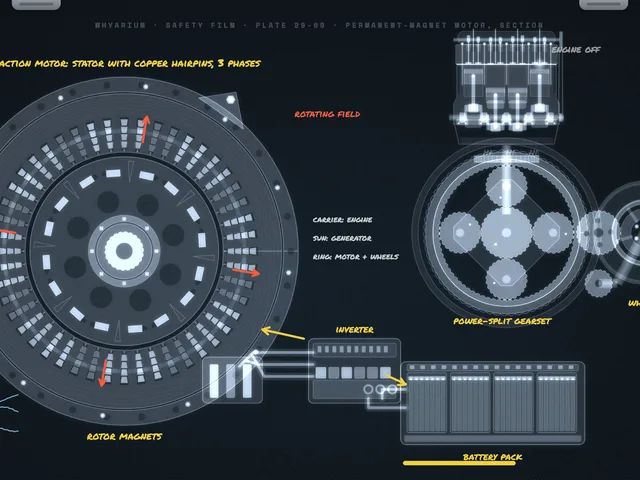
How it works
- The stator. The fixed outer ring carries copper coils in slots, wired as three phases. The electronics feed them alternating currents, a third of a cycle apart.
- A rotating field. Because the three phases peak one after another, the strongest magnetic pull moves around the ring. Faster switching means a faster rotating field.
- The rotor. Permanent magnets on the rotor are dragged round by the field. The controller keeps the field just ahead of the magnets, so the motor pulls with full force even from a standstill.
- Regenerative braking. Lift off, and the controller lets the wheels drive the motor instead. Now it is a generator: it slows the car and sends current back into the battery.
- The hybrid. A hybrid pairs this motor with a petrol engine. At low speed it can run on electricity alone; when accelerating hard both work; when braking the motor recharges the battery.
By the numbers
>90 %of the electric energy a motor turns into motion
0 rpmwhere an electric motor already gives full torque
1997the first mass-produced hybrid car went on sale, in Japan
≈ 1–2 kWha typical full hybrid's battery; an electric car's holds 40–100
Worth knowing
Because a motor is so efficient and can recover braking energy, a hybrid saves the most fuel in towns, with constant stopping and starting. On a motorway at steady speed the petrol engine does almost all the work.
When it goes wrong
- Reduced range
- The battery slowly loses capacity with age and many charge cycles.
- Warning light, limp mode
- A fault in the inverter or a cell sensor; the car limits power to protect itself.
- Whine from the motor
- Usually normal: the switching electronics make an audible tone.