How it works
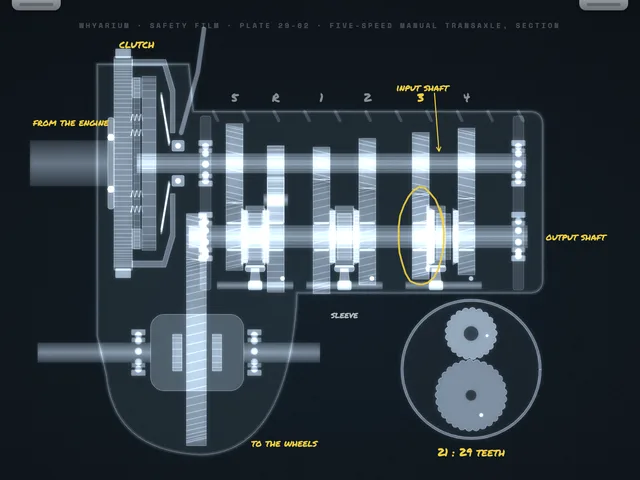
- The clutch. A friction disc sits between the engine's flywheel and a pressure plate. A strong diaphragm spring clamps them together, so the disc turns with the engine. Pressing the pedal pulls the plate back and the engine is disconnected.
- Two shafts. The input shaft comes from the clutch. Below it, the output shaft leads to the differential. Each pair of gears between them gives one ratio: a small gear driving a big one gives slow speed and lots of force.
- All gears in mesh. The gears are always meshed. On the output shaft they spin freely on bearings, so most of the time they do nothing at all.
- The selector. A sliding sleeve, splined to the output shaft, moves sideways and locks one free gear to the shaft. Only that gear now drives.
- Synchromesh. Before the sleeve's teeth engage, a brass synchro ring rubs on a cone on the gear and brings it to the same speed. That is why modern gearboxes shift without grinding.
By the numbers
3.551st gear in this box (11 teeth drive 39)
0.855th: an overdrive, the output turns faster than the engine
4.06final drive: the differential's own reduction
14.4×engine turns per wheel turn in 1st
≈ 3,000engine rpm at 100 km/h in 5th, with this box and tyres
50teeth in every pair: same spacing between the shafts
Worth knowing
Reverse needs one more gear. A small idler wheel between the input and output shafts flips the direction of rotation, which is why reverse often whines: its teeth are usually cut straight, without the quiet helical angle of the forward gears.
When it goes wrong
- Revs rise, car doesn't
- A worn clutch disc slipping: it can no longer pass the engine's torque.
- Grinding when shifting
- Worn synchro rings, or a clutch that doesn't fully let go.
- Judder when pulling away
- Oil on the clutch disc or an uneven flywheel surface.
- Whine that changes with speed
- Worn bearings or gear teeth in the box.