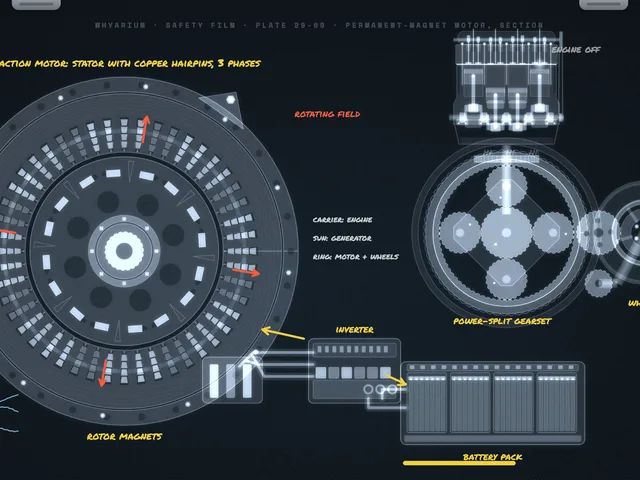
How it works
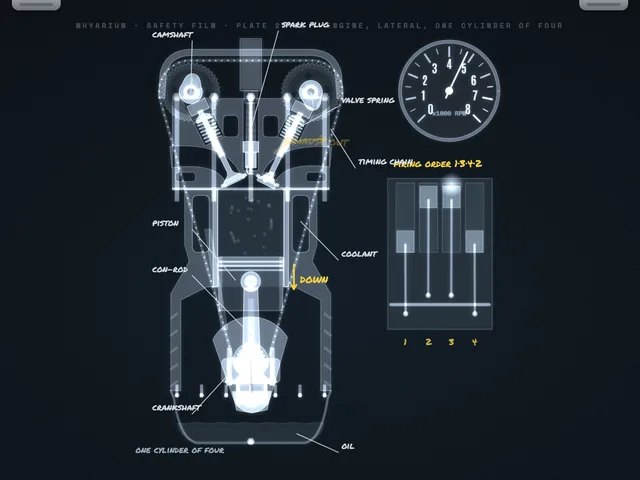
- Intake. The piston slides down with the intake valve open. Air, with a fine mist of petrol, is drawn into the cylinder.
- Compression. Both valves close and the piston comes back up, squeezing the mixture to about a tenth of its volume. Squeezed gas burns faster and gives more push.
- Power. Just before the top, the spark plug fires. The burning gas heats up, its pressure jumps, and it shoves the piston down. This is the only stroke that does work.
- Exhaust. The exhaust valve opens and the rising piston pushes the burnt gas out into the exhaust pipe. Then the intake valve opens and it all starts again.
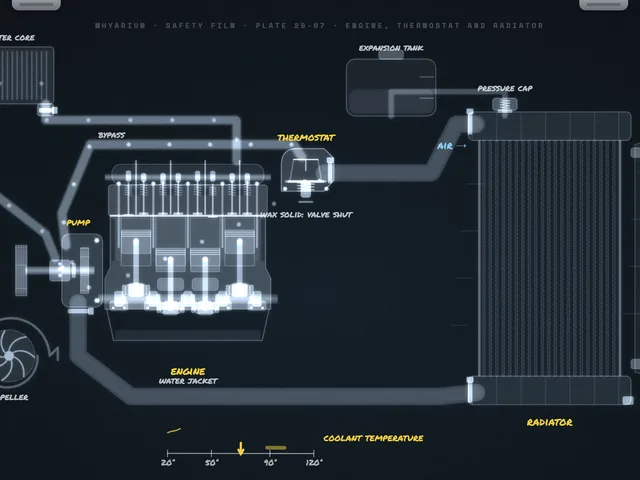
- Crank and cams. The connecting rod turns the up-and-down of the piston into the round-and-round of the crankshaft. A belt or chain from the crankshaft turns the camshafts at exactly half speed, because each valve opens once every two turns.
By the numbers
720°one full cycle: two turns of the crankshaft
1 : 2camshaft speed against crankshaft speed
≈ 10 : 1typical compression ratio of a petrol engine (modern ones run about 10 to 13)
14.7 : 1air to petrol by weight for complete burning
25 / spower strokes per cylinder at 3,000 rpm
≈ 17 m/saverage piston speed at 6,000 rpm with an 86 mm stroke
Worth knowing
In a four-cylinder engine the crank throws are arranged so that a different cylinder is on its power stroke every half turn, in the order 1-3-4-2. That keeps the push on the crankshaft fairly even. Most of the energy in the petrol still leaves as heat: in everyday driving only about a fifth to a third of it ends up moving the car.
When it goes wrong
- Misfire, shaking at idle
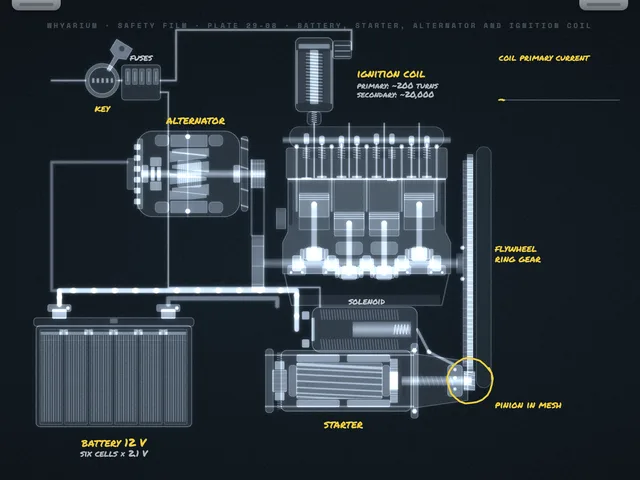
- A worn spark plug or a failing ignition coil, so one cylinder skips its power stroke.
- Blue smoke
- Oil getting past worn piston rings or valve stem seals and burning with the fuel.
- Knocking under load
- Mixture exploding on its own before the spark, usually from heat, carbon or low-octane fuel.
- Sudden silence
- A snapped timing belt or chain. In many engines the valves then hit the pistons.