How it works
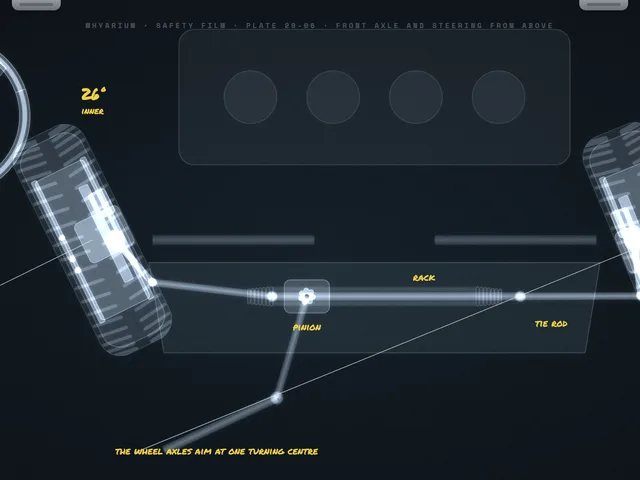
- Pinion and rack. At the bottom of the steering column is a small gear, the pinion. Its teeth mesh with a toothed bar, the rack, which runs across the car inside a tube.
- Tie rods. Each end of the rack has a tie rod with a ball joint. It pushes or pulls the steering arm on the wheel hub, which swings the wheel around its pivot.
- Slow and precise. It takes about three turns of the steering wheel to go from full left to full right, while the road wheels turn only about 35° each way. That gearing makes small corrections easy.
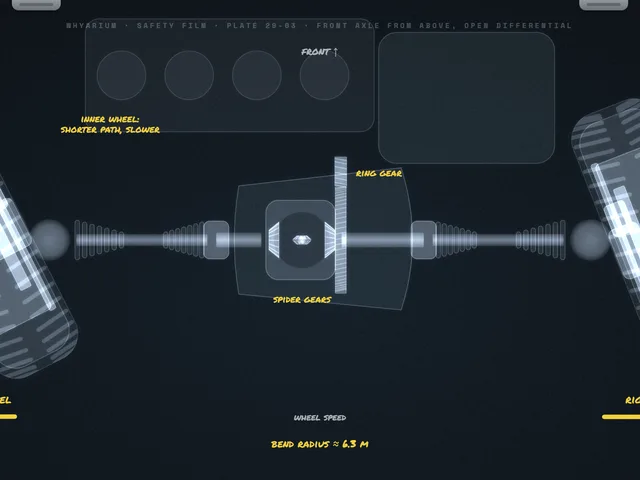
- Ackermann geometry. In a bend the inner wheel follows a tighter circle than the outer one, so it has to turn more sharply. The steering arms are angled so that their lines point roughly towards the middle of the rear axle, and the geometry does this by itself.
- Power assistance. Most cars now help the driver with an electric motor on the column or the rack, controlled by a torque sensor that feels how hard you are turning.
By the numbers
≈ 15 : 1a typical overall steering ratio
≈ 3turns of the wheel from lock to lock
1818Ackermann's patent for steering linkages on carriages
≈ 35°maximum angle of a road wheel
Worth knowing
With the car standing still, the tyre has to be twisted against the road, which is why steering a parked car is heavy without assistance. Once the car rolls, the tyre can follow its new direction and the effort drops sharply.
When it goes wrong
- Free play at the wheel
- Worn tie-rod ends or rack bushes.
- Car pulls to one side
- Wheel alignment out, or uneven tyre pressures.
- Knock over bumps when turning
- A worn inner or outer ball joint.
- Heavy steering
- Failed power assistance: low fluid in older hydraulic systems, a fault in electric ones.