How it works
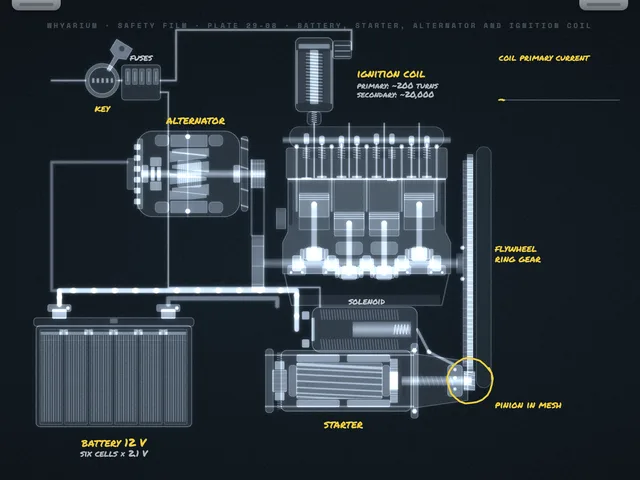
- The battery. Six lead-acid cells of about 2.1 volts each, in a row, give 12.6 volts. It exists mainly to start the engine; once running, the car lives on the alternator.
- The starter. A strong electric motor. A solenoid pushes its small pinion into the teeth around the flywheel and closes a heavy switch. The pinion is much smaller than the ring, so the motor turns the engine at a couple of hundred rpm, enough for it to catch.
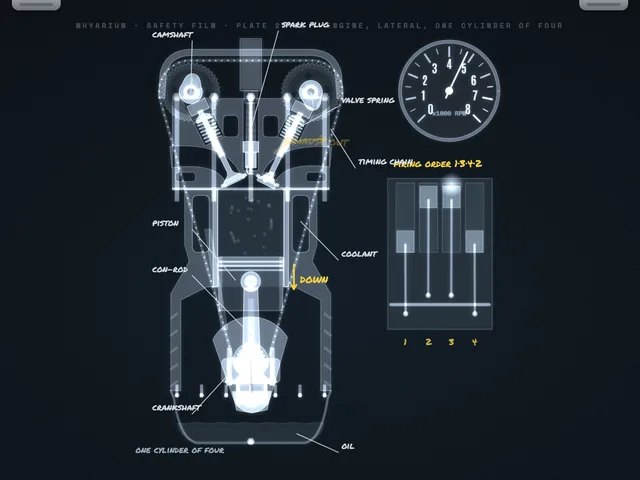
- The ignition coil. Two windings on an iron core: a few hundred turns of thick wire and many thousands of thin ones. Current builds in the first; when it is suddenly switched off, the collapsing magnetic field induces tens of thousands of volts in the second.
- The spark. That voltage jumps the gap of the spark plug as a spark lasting about a thousandth of a second, timed by the engine computer to within a degree of crank rotation.
- The alternator. Belt-driven by the engine, it charges the battery and runs everything electric, holding the system at about 14 volts.
By the numbers
12.6 Va fully charged battery at rest
≈ 14 Vsystem voltage with the engine running
100–300 Athe starter's draw while cranking a petrol engine
20–40 kVthe voltage a coil gives the spark plug
≈ 200 rpmcranking speed
Worth knowing
Modern cars usually have one small coil sitting directly on each spark plug, so no high-voltage cables are needed. Older cars had one coil and a distributor that sent each spark to the right cylinder.
When it goes wrong
- Click, but no cranking
- A flat battery, a corroded terminal, or a stuck starter solenoid.
- Battery light on while driving
- The alternator isn't charging: often a worn drive belt.
- Slow cranking on cold mornings
- An ageing battery that has lost capacity.
- Misfire under load
- A cracked coil or worn plug that can't make a spark against high pressure.